Start with the hazard, not the brochure
University labs in the Klang Valley, hospital diagnostic suites, and private R&D sites in Malaysia often face the same procurement question: do we need a biosafety cabinet, or will a ductless fume hood cover this bench? The two enclosures can look similar from a distance. Their jobs are not interchangeable. One is built around HEPA filtration and infectious aerosols. The other is built around chemical vapour capture, often with carbon or specialty filters when hard ducting is difficult.
CDC and NIH guidance in Biosafety in Microbiological and Biomedical Laboratories (BMBL) treats primary containment as a risk-assessment decision, not a catalogue default. The WHO Laboratory Biosafety Manual monograph on biological safety cabinets and other primary containment devices makes the same point: choose by the protection you need (operator, environment, product) and the agents or chemicals you actually handle. In Malaysian labs that mix molecular work, histology solvents, and teaching practicals, that assessment is the only reliable way to avoid buying the wrong box.
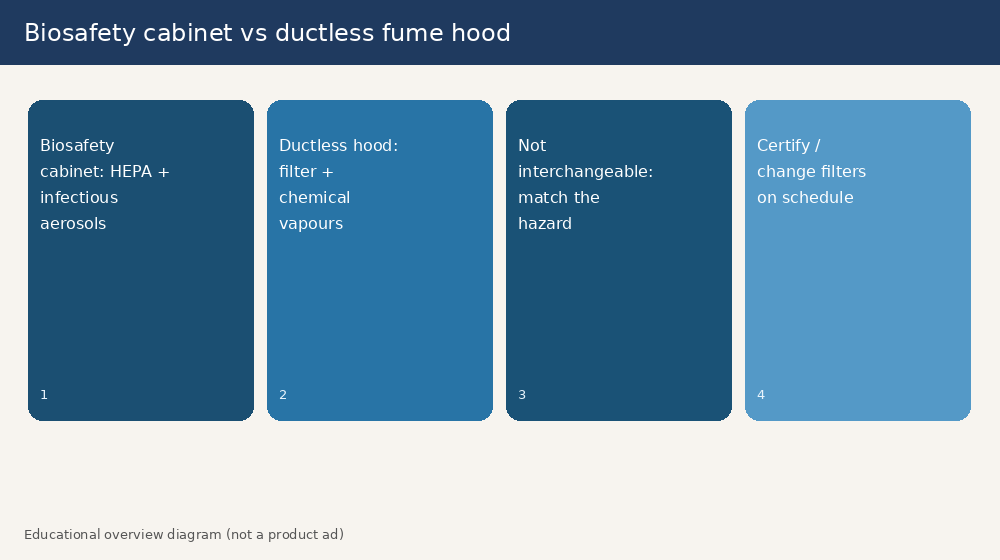
When a biosafety cabinet is the right enclosure
A biosafety cabinet (BSC) is primary containment for work that can generate infectious aerosols or droplets. Class II cabinets, the type most clinical and research labs recognise, use HEPA-filtered airflow to protect the worker, the room, and usually the sample. Class I protects people and the environment but not the product. Class III is a gas-tight glove box for the highest containment work. Annual certification, correct sash height, and disciplined work practices matter as much as the metal shell.
ASPR’s comparison of chemical fume hoods and biosafety cabinets is blunt: a fume hood is not a substitute for a BSC when infectious agents or toxins are involved, and a clean bench that blows filtered air at the worker is not a BSC either. If your Malaysia programme centres on cultures, clinical specimens, or aerosol-generating microbiology, specify the right biosafety cabinet Malaysia class after the risk assessment, then plan certification and training before first use.
Related watch: WHO introduction to biological safety cabinet classes and protection goals.
When a ductless fume hood makes more sense
Chemical work is a different problem. Volatile solvents, fixatives, and many reagents need vapour control, not sterile downflow. A conventional ducted fume hood exhausts outdoors. A ductless unit pulls air through filter media and returns cleaned air to the room, which can help in older buildings, rented suites, or teaching spaces where roof penetrations and dedicated exhaust fans are costly or restricted.
That convenience has boundaries. Filter type and changeout schedules must match the chemicals in use. Overloading carbon beds, mixing incompatible vapours, or treating the hood as an all-purpose “safe box” defeats the design. Use ductless fume hood filtration where chemical hazard assessment supports filtered capture, and keep infectious work on a certified BSC instead of hoping one enclosure covers both.
Keep emergency shower and eyewash in the same plan
Enclosures reduce exposure during normal work. They do not replace spill response. Malaysian labs that handle corrosives, fixatives, or concentrated reagents still need rapid flushing. ANSI/ISEA Z358.1 expects emergency eyewash and shower equipment within about 10 seconds of the hazard, on the same level, with a clear path. OSHA’s medical and first-aid rule likewise calls for suitable facilities for quick drenching or flushing where injurious corrosive materials are present.
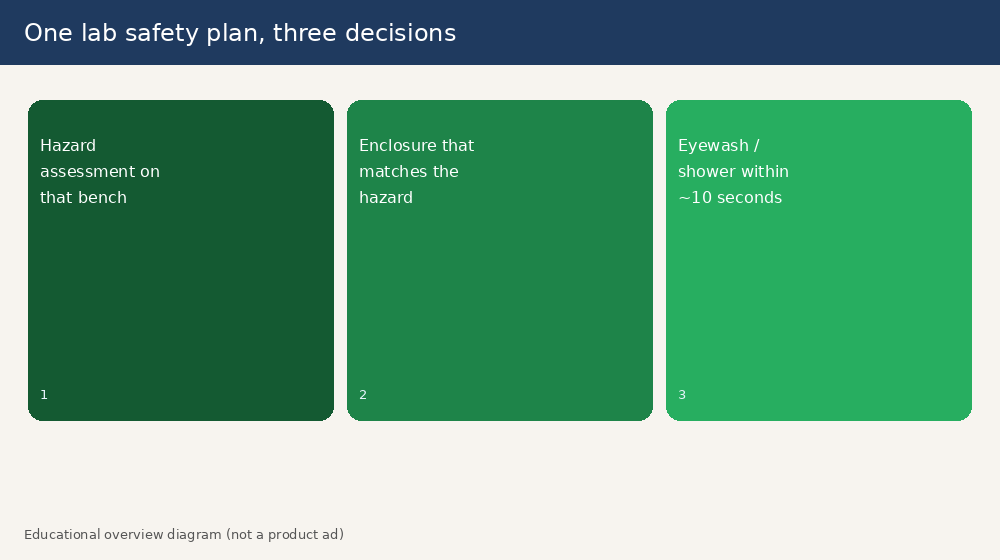
In practice, place plumbed or appropriate portable emergency shower and eyewash units where splash risk is real: near chemical prep benches, staining areas, and autoclave or waste handling zones. Keep travel paths free of carts and closed doors that would slow an injured worker. Weekly activation checks and clear signage belong on the same commissioning list as BSC certification and hood filter logs.
Three lines every lab purchase order should carry
Before you approve drawings or a purchase order, write three lines everyone can defend: (1) the primary hazard on that bench, (2) the enclosure that matches it, and (3) the flush-station distance and water quality that cover splash scenarios. If a protocol mixes infectious steps and volatile chemistry, separate the tasks in space or time rather than forcing one cabinet to do both jobs poorly. Keep those three lines in the same file as the certification and filter-change schedule.
That habit travels well across KL hospitals, campus teaching labs, and industrial QC rooms. Brochure photos age quickly. A documented risk assessment, the right primary barrier, and reachable emergency flushing still read the same on an audit day.